
ProVet
Home Care Veterinarians Management App
PROJECT OVERVIEW
The product
ProVet app is a tool to facilitate the routine of veterinarians who perform home care.
This modality of veterinary care has grown exponentially in recent years, as it provides more comfort for pets and reduces the trauma of transport and new environment.
ProVet has a system that has patient records, clinical records, reminders and vaccine stock.
The target audience of the app is veterinarians who provide home care exclusively or not.
Project duration
October 2022 to December 2022

The problem
Veterinarians who perform home care have difficulties in organizing their professional routine. As a veterinarian, I noticed how many of my colleagues already had problems with organizing routine information on appointments (patient data, return dates, vaccine stock control, among others). This raised the question: "How can these professionals make their routine easier and reduce their mental overload?“ A gap was identified in this area, with no specific tool for this type of professionals.
The goal
Improve the routine of veterinarians, reducing mental overload and also benefiting patients, who will have better traceability and follow-up care, thus improving quality.
My role
UX designer leading the app and responsive website design from conception to delivery.
Responsibilities
Conducting interviews, paper and digital wireframing, low and high-fidelity prototyping, conducting usability studies, accounting for accessibility, iterating on designs and determining information architecture.
User research: summary
I used information gained through conversations with veterinarians colleagues who provide home care to better develop the user interview questions.
During the interviews, most participants reported that the demand for home care has grown a lot since the pandemic and that they feel a lack of tools for organizing the routine of care that are aimed at this type of care - since most are directed to veterinarians linked to clinic and hospital. Most participants feel a mental overload regarding the numerous activities involving the general organization of home care. The feedback received through the survey made it clear that users would be open and willing to use a tool that was practical and simple to organize their professional routines.

Persona 1: Vanessa
Persona 2: Amadeu

Competitive audit
An audit of a few competitor's products provided direction on gaps and opportunities to address with the ProVet app.

Ideation
I did a quick ideation exercise to come up with ideas for how to address gaps identified in the competitive audit.
My focus was on quick notes, reminders and clinical information management.


Digital wireframes
After ideating and drafting some paper wireframes, I created the initial designs for the ProVet app. The designs were focused on viewing the initial screen, adding a new patient's clinical record and tutor.

Option to insert patient photo for better identification
Clinical data organized by topics to facilitate the organization of information


Low-fidelity prototype
To prepare for usability testing, I created a low-fidelity prototype that connected the user flow of the main feature of the app.

Quantitative study: parameters
Study type:
Survey study
Participants:
57 veterinarians
Location:
Brazil, remote
Length:
5 minutes
Quantitative study - veterinarians: findings

Quantitative study: parameters
Study type:
Survey study
Participants:
102 pet owners
Location:
Brazil, remote
Length:
5 minutes
Quantitative study - pet owners: findings

Usability study: parameters
Study type:
Unmoderated usability study
Participants:
7 participants (veterinarians)
Location:
Brazil, remote
Length:
15 – 20 minutes
Usability study: findings
These were the main findings uncovered by the usability study:
1
Convenience in login
People said they don't like bureaucracy to log into the account and use the app's features
2
Screen output
People had difficulty leaving the screen intuitively
3
Feedback
People would like to see feedback message after a task is completed
Mockups
Most of the screens changed, adding the "x" exit symbol in the upper right corner, to make leaving the screen easier and more intuitive. Thus, I also saw that the “back button” was not very useful and users ignored its existence, so I deleted it.
Before usability study
After usability study


Mockups
The feedback message has been changed to something simpler and with less cognitive overhead. Another change was that this message does not appear on a full screen, but in an overlay, as the user is better situated and will know which task this message is related to.
Before usability study
After usability study


Mockups
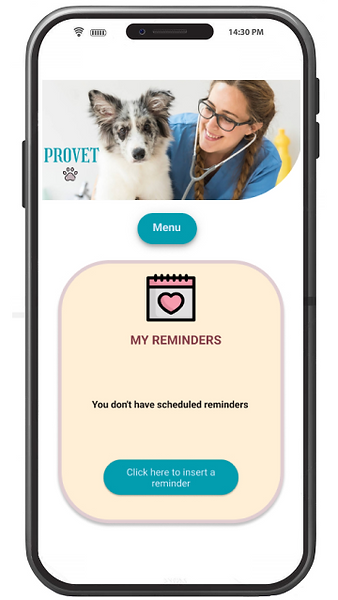


High-fidelity prototype
The high-fidelity prototype followed the same user flow as the low-fidelity prototype, including design changes made after the usability study.

Next steps
1
Improve the prototype and design the user flows involving all the app's functionalities
2
Conduct new usability research to verify how intuitive and simple the app's main tasks are
3
Perhaps it would be interesting to carry out more specific tests with other tools similar to the ProVet app, something more funneled than the competitive audit, to discover the gaps in a deeper way
Takeaways
Impact
Users shared that the app looks like it will make the busy routine of home care veterinarians a lot easier. A quote from a colleague was: "The ProVet app seems to be a simple and dynamic tool for annotating clinical data. My routine is divided between traffic, rain, scratches and the most unusual situations possible, therefore, having a specific tool for the my routine will make all the difference!"
What I learned
I learned that even within a niche, there are many situations to be explored and gaps that can be filled to benefit countless users. Therefore, it is important to specialize in the problem in order to understand its characteristics in depth, as well as to propose possible solutions. Ah, with this project I discovered the incredible Figma tool, but I realized that I need a specific course to better carry out my prototypes, I included it in my list :)